


For US tech startups, nearshore team augmentation services from Latin America hit the specific balance point that domestic hiring and offshore outsourcing both miss: fast deployment, real-time collaboration, and 40-60% lower cost than US engineers.
That's not a marketing premise. It's arithmetic. Hiring a senior US engineer takes four to six months and runs $252,000-$325,000 per year fully loaded, according to Merlion Technologies. A vetted LATAM nearshore engineer can be contributing to your team in two to four weeks, at $45-$140/hr depending on seniority and country.
The offshore alternative is structurally worse for early-stage teams. Asia-based developers sit 10-12 time zones away. Every standup becomes a scheduling puzzle. Every code review waits until the next morning. For a startup iterating weekly, those delays stack across every sprint.
Why LATAM's timezone overlap changes the math
The 0-4 hour overlap between LATAM and US East Coast is the structural advantage that makes nearshore augmentation work. Same-day code reviews, real-time incident response, and synchronous standups are all on the table without anyone working at 3 a.m.
According to Gitnux, 57% of companies report improved communication with nearshore teams, and 70% cite timezone alignment as the key benefit. But there's a less-discussed data point worth naming: DORA research shows nearshore development velocity is 28% higher than offshore. That gap doesn't come from raw skill differences. It comes from timezone alignment compounding across every sprint, every blocked pull request, every production incident caught the same day instead of the next morning. For a startup running two-week sprints, 28% faster throughput is the difference between six releases and eight in a quarter.
The broader market has registered the shift. Gitnux data shows 62% of US firms adopted nearshore development in 2023, and 78% prefer nearshore over offshore specifically for cultural fit.
What nearshore staff augmentation actually means for your engineering team
Nearshore staff augmentation means pre-vetted engineers embed directly into your team, report to you, and operate inside your processes. The vendor provides the talent. You provide the direction.
That's the critical distinction from managed services or project outsourcing, where delivery ownership sits with the vendor. In augmentation, you retain full IP ownership and technical direction. Engineers work in your GitHub repo, your Jira board, your Slack workspace, and your CI/CD pipeline from day one.
The roles most commonly filled via nearshore augmentation include full-stack, back-end, and front-end engineers; QA automation engineers; DevOps and SREs; data engineers; AI/ML specialists; mobile developers; and product managers, per LatamCent. The startup-specific advantage is flexibility: scope and priorities can shift mid-project without extra fees or timeline resets that fixed-scope contracts impose. TekRecruiter documents a concrete example: a fintech startup added real-time analytics and fraud detection capabilities mid-project during a legacy system rewrite, with no delay or cost penalty.
The real cost range for LATAM nearshore augmentation
LATAM nearshore augmentation runs $45-$140/hr, saving 40-60% compared to US domestic augmentation at $85-$250/hr, per Accelerance 2023 and Grand View Research 2023 data via Nearshore Business Solutions.
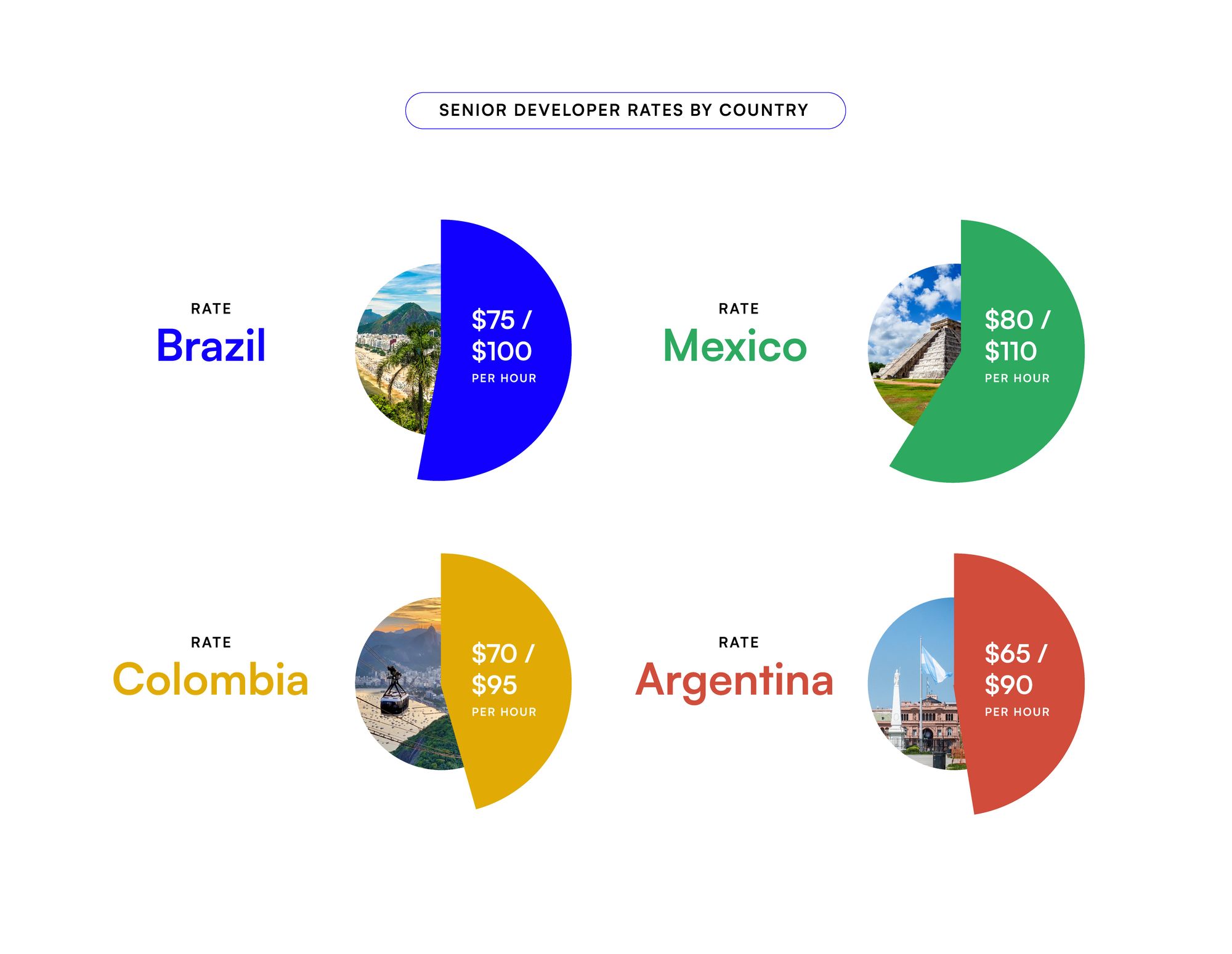
Senior developer rates by country:
- Brazil: $75-$100/hr
- Mexico: $80-$110/hr
- Colombia: $70-$95/hr
- Argentina: $65-$90/hr
At those rates, a five-person senior team at 2,000 hours per year saves $700,000-$900,000 annually compared to US equivalents. On a single 1,000-hour project, LATAM nearshore rates of $60-$75/hr versus US firm rates of $100-$200/hr translate to $25,000-$125,000 in savings, per TekRecruiter.
One thing most founders skip: understanding what's inside the bill rate. According to Nearshore Business Solutions, roughly 60% goes to developer pay, 12% to benefits, 12% to overhead, 13% to margin, and 3% to bench costs. Ask any provider to break this down before you sign. A low headline rate with thin bench coverage means you absorb re-staffing risk if an engineer leaves mid-engagement.
How the three main provider types compare
Three distinct nearshore provider models serve different startup stages, per Ideaware.
Premium global talent marketplaces (Toptal is the common reference point) charge $150-$200/hr, screen the top 3% of applicants, and typically take two to four weeks to place an engineer. Best for teams where budget isn't the constraint and rare specialization matters more than speed.
Enterprise-scale nearshore firms (BairesDev fits this profile) charge $50-$90/hr, claim the top 1% from a pool of 4,000+ developers, and take one to three weeks to hire. The catch for startups: added management layers slow agility, and their default engagement model suits teams needing 10+ engineers through formal procurement processes.
Startup-focused nearshore boutiques move faster, with candidate shortlists within 48 hours and full productive teams onboarded in 10-14 days. Direct engineer access and leaner communication structures fit the 1-10 developer need common at early stages.
Elaniin sits in this third category: a LATAM-based provider with offices in the US, Mexico, El Salvador, and Guatemala, 200+ engineers covering Java, JavaScript, React, Node.js, MySQL, MongoDB, React Native, PHP, and Vue.js, 12+ years delivering tech solutions, and a Clutch Global Top 1,000 ranking. For a startup that needs a senior React and Node.js engineer contributing by sprint two, that profile matters more than an enterprise firm's headcount.
What to verify before you commit to a provider
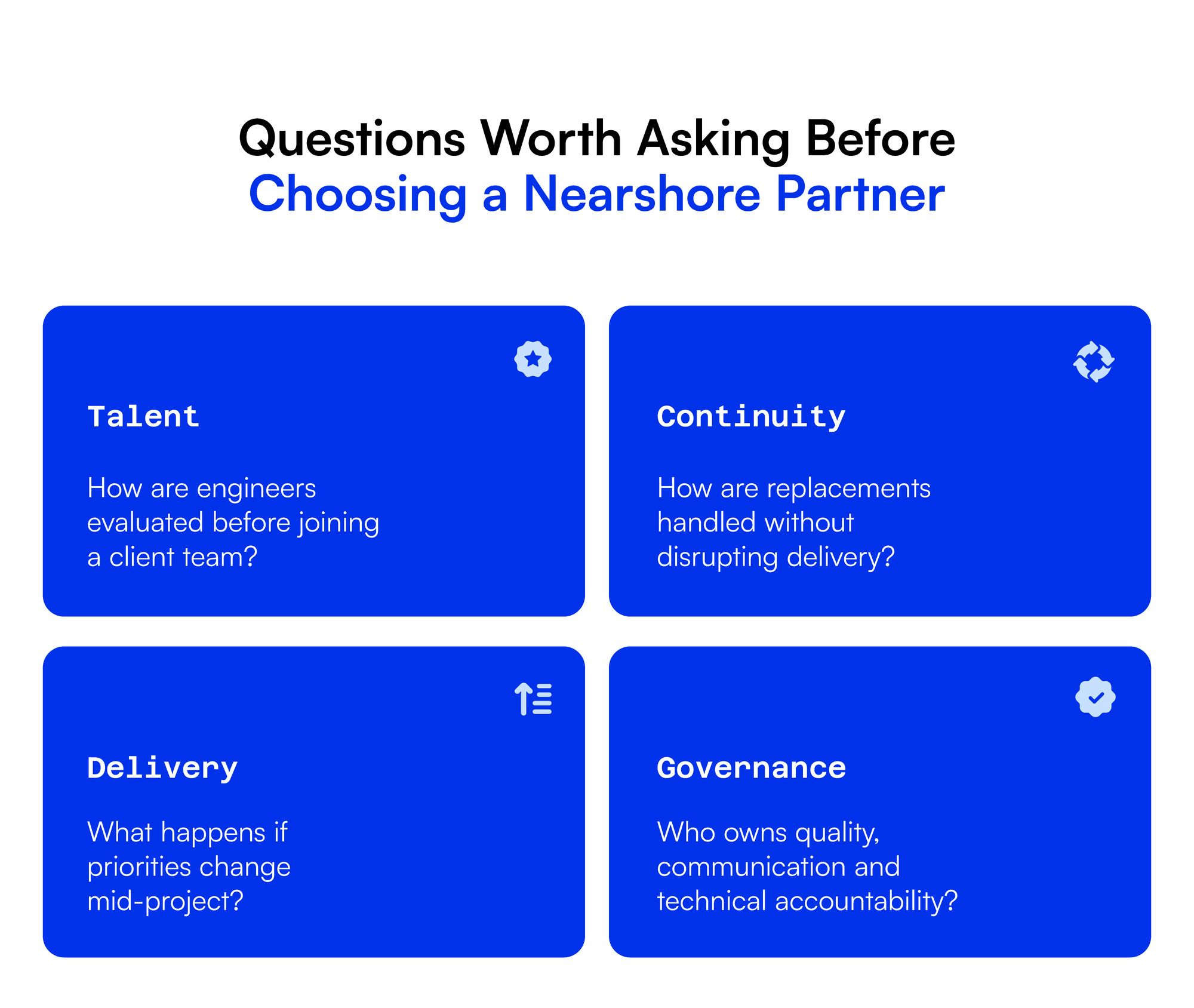
The most important evaluation criteria aren't on any provider's homepage. Per HireWithNear, the right filters are:
- Vetting transparency: Ask what the screening test is, what the pass rate is, and what the sample size looks like. "Top 3%" is a marketing claim without those specifics.
- Third-party reviews: Look for verified outcomes on G2 or Clutch with a minimum 4.6 rating. Vendor-produced case studies tell you what the vendor wants you to believe.
- Tech stack alignment: Confirm production experience in your actual stack. "We work with React" is different from engineers who have shipped React applications under production load.
- IP ownership: This should be unambiguous in the contract before any code is written.
- Replacement guarantees: Ask what happens if an engineer leaves mid-engagement. Knowledge transfer gaps at contract end are a documented risk, per Merlion Technologies.
- Tooling readiness: Verify engineers are already proficient in your CI/CD setup, not just capable of learning it eventually.
Caveats worth naming before you scale
Nearshore staff augmentation has real risks. Vendor lock-in is possible if a provider's talent bench is narrow. Ask about bench depth before committing to a long-term engagement. The headline hourly rate also doesn't capture management overhead: expect at least one sprint of ramp-up time as augmented engineers learn your codebase and communication norms. Hardware provisioning, security access, and compliance requirements sometimes surface late; raise them in the scoping conversation before kick-off.
One framing shift that helps: nearshore augmentation amplifies whatever clarity or chaos already exists in your technical direction. If you haven't defined your architecture yet, more engineers won't resolve that. The model works best when you can specify what needs to be built, even loosely.
Caveats worth naming before you scale
The lowest-risk way to evaluate a nearshore team augmentation provider is a one-to-two engineer pilot on a defined two-sprint workload. Real code, real communication, real feedback cycles before you expand the engagement.
Prioritize providers who surface candidates within 48-72 hours. Slow initial response usually predicts slow escalations and slow replacements later. Use the full cost model, not just the hourly rate: add onboarding time, tooling access, and management overhead to get a real comparison.
If your next growth constraint is engineering capacity, reach out to Elaniin now, before the hiring crunch hits. A conversation when you have runway gives you options. A conversation when a sprint is already late doesn't.